Honest Well Repair and Expert Troubleshooting When Your Taps Run Dry
Well Repair & Troubleshooting
Our Services
Why settle for guessing games or automated phone trees? Our family brings five generations of deep well troubleshooting expertise directly to your backyard to restore your water safely and permanently.
Emergency Priority & Dispatch Status
When a household water system fails, it is an absolute emergency. We utilize a dedicated Order of Urgency protocol to ensure our community stays safe and families are never left stranded.
- Our Triage Commitment: We prioritize households experiencing a total loss of water over routine maintenance calls. This live status management allows us to dispatch our local technicians as efficiently as possible while maintaining complete operational integrity. We treat your family like our neighbors, routing support based on immediate human need rather than rigid corporate windows.
Backyard Realities: Repairing NC Terrain Issues
Well water troubleshooting cannot be learned from a generic handbook. Private systems depend entirely on the unique geography of the North Carolina Piedmont. Our field crews are specifically trained to identify and solve the distinct problems caused by local ground conditions.
- Fighting Thick Red Clay: In counties like Rowan and Cabarrus, heavy red clay puts an immense strain on sub-surface components. Silt and clay buildup can quickly choke water intake slots or cause torque damage to the pump motor.
The Residential Engineer Difference
- Navigating Deep Bedrock Cracks: For properties near Lake Norman or throughout the western valley, wells are drilled deep into solid granite. Water hides within tiny fractures in the stone. If a pump is not calibrated correctly for the specific yield and drop-off rate of your well shaft, you will experience sudden pressure drops.
- Verified Local Compliance: Your private well is your family’s source of health and security. We actively field North Carolina Certified Well Contractors holding active Level A and Level B credentials. This baseline ensures every repair complies fully with state environmental safety frameworks and local building codes.
Immediate Safety Checks Before We Arrive
While our field crew reviews your intake request and coordinates our closest available unit, please perform these quick safety steps to protect your property and speed up our on-site diagnosis:
Check the Breaker Box: Locate the dedicated electrical breaker for your well pump. If it has tripped, flip it entirely to the “Off” position and then back to “On” exactly once. Note if it trips again immediately.
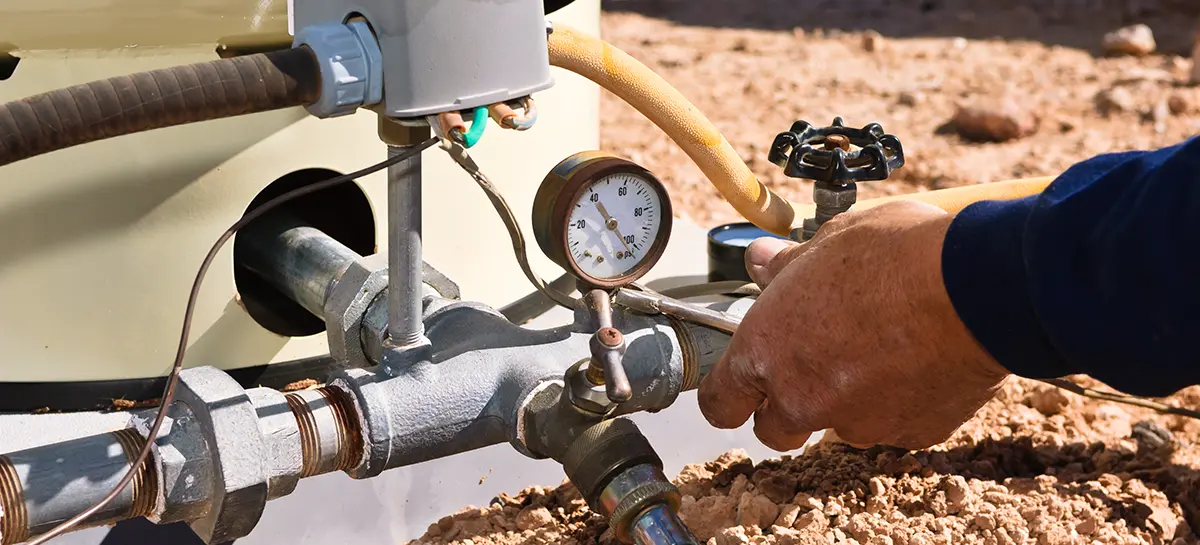
Check Your Pressure Gauge: If you can safely access your pressure tank (typically located in a garage, crawlspace, or well house), look closely at the small round dial. Note whether the needle is resting at 0 PSI or if it shows normal pressure even though no water enters the home.
Protect Your Equipment: If you hear your well pump rapidly turning on and off (clicking continuously), switch the breaker off immediately. This simple step prevents the expensive motor from burning out before our technician arrives on site.
5 Signs Your Backyard Well System is Warning You
Your home well system rarely fails out of nowhere without giving you subtle warnings first. Catching these early signs allows us to fix a single small part, saving you from a total breakdown that leaves your family completely without water.
1. Sputtering or “Spitting” Faucets
The Symptom: Your taps cough, sputter, or blast out pockets of trapped air instead of pouring a smooth, steady stream.
The Reality: Air should never be inside your home plumbing lines. Sputtering usually means an underground pipe has cracked inside your well, a connection has shaken loose, or the local water table has dropped below your pump intake during heavy seasonal use.
2. Rapid Clicking from the Control Box
The Symptom: You hear a fast, constant clicking sound coming from your well house, garage, or crawlspace control box every time water runs.
The Reality: This rapid cycling will quickly destroy your equipment. It means your pressure tank has lost its vital air cushion, usually because the internal rubber bladder has broken. Without that air buffer, your pump motor is forced to turn on and off dozens of times an hour, causing it to overheat and burn out.
3. Sudden or Creeping Drops in Water Pressure
The Symptom: The shower pressure drops whenever the washing machine runs, or your kitchen faucet takes a frustratingly long time to fill up a pot.
The Reality: While it is easy to assume the pump is dying, a slow drop in pressure is often caused by a failing pressure switch, a clogged filter, or a hidden underground pipe leak. In our local North Carolina Piedmont terrain, low flow can also mean mineral buildup or iron bacteria is beginning to choke the pump intake.
4. Murky, Discolored, or Gritty Water
The Symptom: Your tap water suddenly looks cloudy, turns a reddish brown color, or leaves sand and grit at the bottom of your glass.
The Reality: When muddy water comes out of your taps, your well’s physical barriers are compromised. A pump hanging too low can stir up natural sediment from the bottom of the well. This cloudiness can also mean your well casing has cracked, allowing thick local red clay and surface runoff to leak straight into your drinking supply.
5. An Unexplained Spike in Your Electric Bill
The Symptom: Your monthly power bill jumps dramatically, even though your family has not changed its normal daily electricity or heating habits.
The Reality: Your deep well pump uses a massive amount of electricity. If a small underground valve fails, water flows backward down into the well, dropping your home’s water pressure and forcing the pump to run nearly 24 hours a day to keep up. A worn, failing motor will also pull a lot of extra power as it struggles to turn.